> ## Documentation Index
> Fetch the complete documentation index at: https://docs.flipsuite.xyz/llms.txt
> Use this file to discover all available pages before exploring further.
# Setup
> Create a storefront, add items, and open it for purchases.
> Setting up a storefront starts with creating the storefront itself, then adding items with prices and deliverables.
> This guide walks through the full dashboard flow.
## Step 1 - Create a storefront
Open the **Storefronts** area in your community dashboard and click **Create new storefront**.
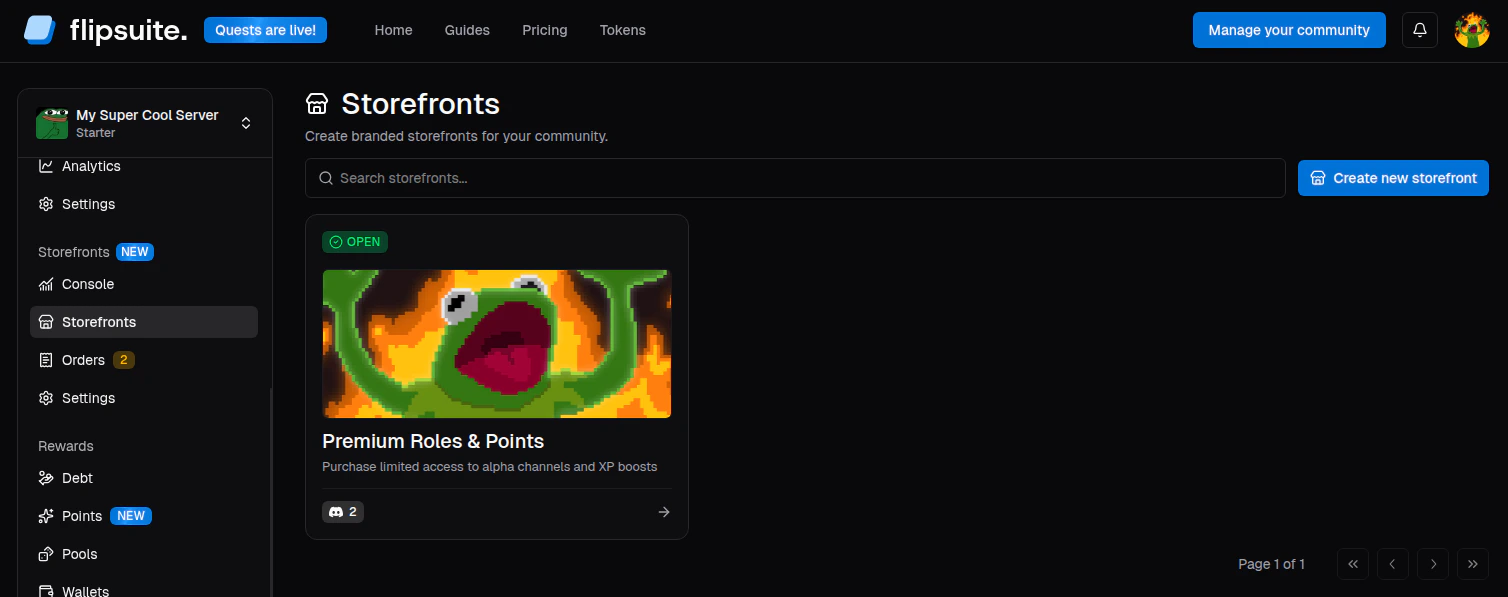 When creating a storefront, you can configure:
* **Name**: Public storefront title shown on storefront cards.
* **Description**: Short summary of what this storefront is for.
* **Banner**: Optional banner image to give your storefront a unique look.
* **Discord channel**: Channel where the storefront should be shared after it's opened.
## Step 2 - Add storefront items
After creating the storefront, you will be taken to its **Items** tab. Click **Add new item** to create your first item.
When creating a storefront, you can configure:
* **Name**: Public storefront title shown on storefront cards.
* **Description**: Short summary of what this storefront is for.
* **Banner**: Optional banner image to give your storefront a unique look.
* **Discord channel**: Channel where the storefront should be shared after it's opened.
## Step 2 - Add storefront items
After creating the storefront, you will be taken to its **Items** tab. Click **Add new item** to create your first item.
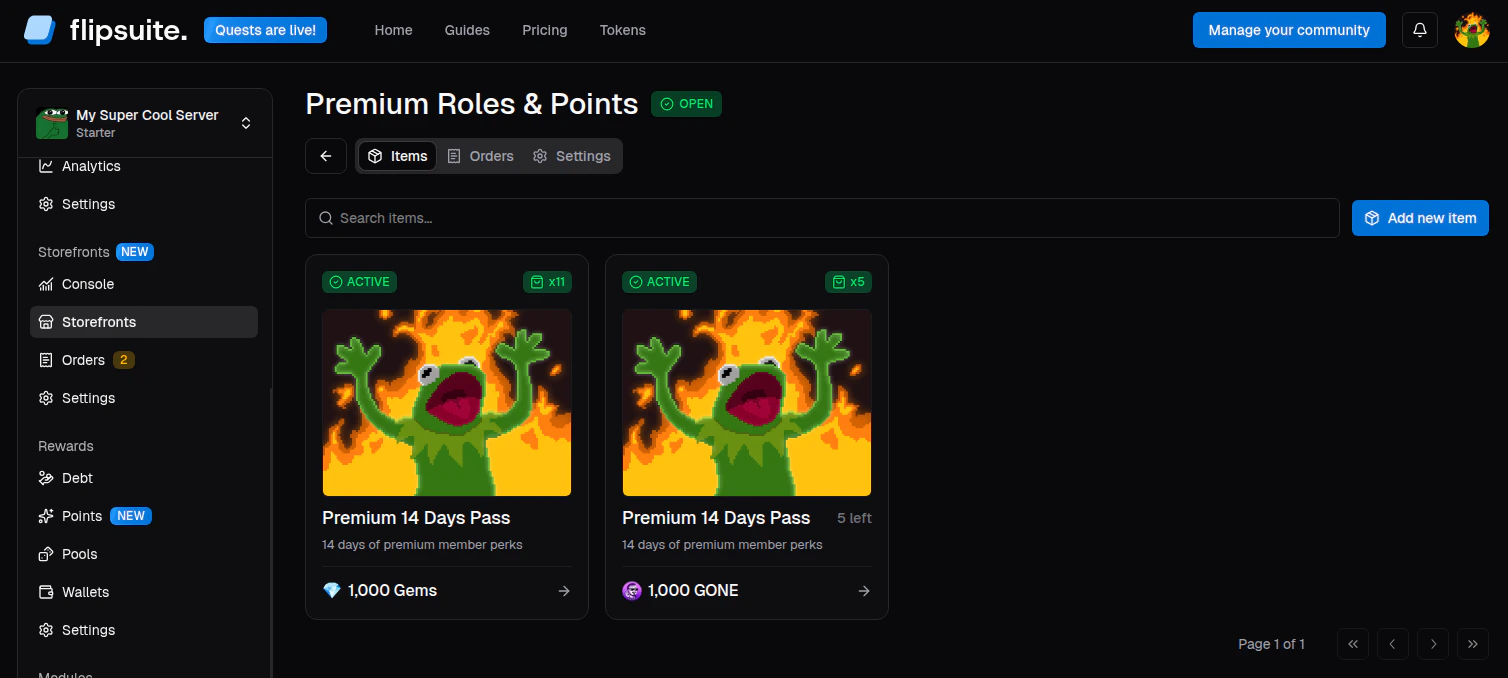 Each item includes:
* **Name**: Public item name shown to buyers.
* **Short description**: Compact summary shown on item cards.
* **Full description**: Longer markdown description with extra details or claim instructions.
* **Image**: Optional item image.
* **Stock**: Remaining quantity available for purchase. Leave it empty for unlimited stock.
* **Limit per user**: Optional purchase cap per person.
* **Allow gifting**: Whether buyers can send the item to another community member.
* **Deliverables**: Everything the buyer should receive after a successful payment.
* **Requirements**: Optional eligibility checks or buyer inputs collected during checkout.
* **Price**: The payment option for the item.
## Step 3 - Open the storefront
When your catalog is ready, open the storefront's **Settings** tab and update its **Visibility**:
* **Yes**: Buyers can purchase from it.
* **No**: The storefront stays visible in the dashboard, but purchases are blocked.
Each item includes:
* **Name**: Public item name shown to buyers.
* **Short description**: Compact summary shown on item cards.
* **Full description**: Longer markdown description with extra details or claim instructions.
* **Image**: Optional item image.
* **Stock**: Remaining quantity available for purchase. Leave it empty for unlimited stock.
* **Limit per user**: Optional purchase cap per person.
* **Allow gifting**: Whether buyers can send the item to another community member.
* **Deliverables**: Everything the buyer should receive after a successful payment.
* **Requirements**: Optional eligibility checks or buyer inputs collected during checkout.
* **Price**: The payment option for the item.
## Step 3 - Open the storefront
When your catalog is ready, open the storefront's **Settings** tab and update its **Visibility**:
* **Yes**: Buyers can purchase from it.
* **No**: The storefront stays visible in the dashboard, but purchases are blocked.
 If you set a **Discord channel**, Flipsuite will share the storefront there when it becomes open.
If you later change the channel or close the storefront, the old storefront message is cleaned up automatically.
## Step 4 - What's next?
Once the storefront is open, focus on the building blocks around it:
Learn how points and token pricing work in storefront items.
Choose what buyers receive after payment succeeds.
Configure where token payments should be sent.
Track purchases and manage custom item fulfillment.
If you set a **Discord channel**, Flipsuite will share the storefront there when it becomes open.
If you later change the channel or close the storefront, the old storefront message is cleaned up automatically.
## Step 4 - What's next?
Once the storefront is open, focus on the building blocks around it:
Learn how points and token pricing work in storefront items.
Choose what buyers receive after payment succeeds.
Configure where token payments should be sent.
Track purchases and manage custom item fulfillment.